Types of Angles: Names, Degrees and Examples
Most adults can sort a 30° angle from a 90° at a glance, but accuracy collapses once the gap narrows to a few degrees. A few weeks of daily practice is usually enough to get consistent within 10°. The tools that help most: the triangle angle sum, a handful of anchor degrees, and the habit of reading an angle as a rotation rather than a static wedge.
This guide covers the five types of angles with their degree ranges, the triangle rule, and a few mental shortcuts for reading degrees by eye before playing the daily angle quiz.
What is an angle?
An angle is the opening between two rays that share an endpoint, called the vertex. It is measured in degrees: a full turn is 360°, a straight line is 180° and a square corner is 90°. Angles are named by how many degrees they cover, which gives the five types below.
The five angle names
A quick review:
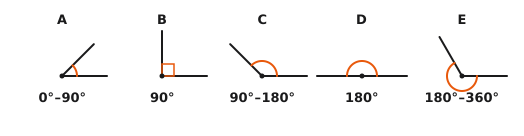
| Type of angle | Measures |
|---|---|
| Acute | more than 0°, less than 90° |
| Right | exactly 90° |
| Obtuse | more than 90°, less than 180° |
| Straight | exactly 180° |
| Reflex | more than 180°, less than 360° |
Right angle (90°). Exactly a quarter turn: the corner of a square, a sheet of paper, or a wall meeting the floor. It is drawn with a small square at the vertex instead of an arc, and it is the boundary between acute and obtuse.
Straight angle (180°). Exactly a half turn: the two rays point in opposite directions and form a straight line through the vertex. It is the boundary between obtuse and reflex, and any angle plus its supplement makes one.
Acute means smaller than the L (a pizza-slice tip, clock hands at 2 o'clock).
Obtuse means wider than the L but not yet flat, like a reclining chair pushed back a little.
The category that trips people up is reflex. A reflex angle is anything past 180° on its way to 360°, so it reads as the “outside” of an angle: the large piece of pie left behind once a small acute slice is cut out. Two facts worth noting:
- Every reflex angle has a partner under 180° sitting opposite it on the same vertex. The pair sums to exactly 360°.
- Reflex angles show up in the daily puzzle. The target lands anywhere from 1° to 359°, and roughly half the puzzles cross 180. Reading the arc-on-the-outside shape matters on those days.
How many types of angles are there?
Five, when angles are classified by size: acute, right, obtuse, straight and reflex. Lists of seven or more add relationships between two angles rather than new sizes: complementary (two angles that sum to 90°), supplementary (sum to 180°), adjacent (sharing a ray) and vertical (opposite each other where two lines cross). A full turn of 360° is sometimes counted as a sixth type.
How to pin an angle down
Three things to keep in mind for any unknown angle: anchors, partners, and the triangle rule. Anchors first. Lock in the positions of 45°, 90°, and 135°, then bisect from there. Closer to 90 or to 135? Closer to 135. Closer to 135 than to 120? Probably. Call it 130. That is the whole estimation game.
Partners are the complementary and supplementary rules. Two angles meeting at a straight line add to 180°, so if one is 70°, the other is 110°. The same idea applies with 90° (complementary). Much of school geometry is this rule in different costumes.
The protractor deserves a mention for completeness: center on the vertex, line up one ray with 0°, read where the other ray crosses. The estimation skill matters more when no protractor is available, which is the case Angledle trains.
The triangle rule (180, always)
The single most useful rule in school geometry. The three interior angles of any triangle always add to 180°. Know two, subtract from 180, and the third drops out. No exceptions, no special cases.
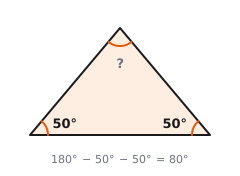
Quick example: an isosceles triangle with two 50° base angles. Apex is 180 − 50 − 50 = 80°.
The rule applies to every triangle: equilateral, scalene, right, obtuse. The sum is always 180. When an angle hides inside a triangle in a puzzle, look for two other interior angles that can be read directly. Usually one is a right angle or the base of an isosceles pair, which makes the rest straightforward.
A degree as a slice of a spin
Degrees click faster when treated as fractions of rotation rather than memorized values. One degree is 1/360th of a full turn. A full spin is 360°. Half a spin is 180°. A quarter is 90°. Once a degree feels like a piece of rotation instead of a static fan-shape, estimation becomes easier.
A few anchor degrees worth memorizing, because they appear constantly:
- 30°: one hour on a clock face, or the small angle in a 30-60-90 triangle.
- 45°: the diagonal of a square.
- 60°: each angle in an equilateral triangle.
- 120°: the interior angle of a regular hexagon (and the angle at which three roads meet in an even three-way junction).
Past 180° sits reflex territory. Angledle's daily target ranges from 1° to 359°, so reflex values do come up. In trigonometry or robotics, 270° is three-quarters of a turn and 360° returns to the start. That cyclical wraparound is what lets one number describe any rotation, no matter how many full spins it contains.
Common mistakes
The most common mistake is reading the smaller angle when the puzzle is asking for the larger reflex angle. If the marked arc goes the long way around the point, subtract the smaller-looking angle from 360.
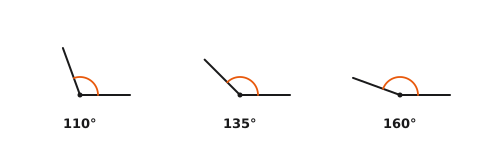
Another common miss is treating every wide angle as “about 120.” There is a big visual difference between 110°, 135°, and 160°, but it takes practice to see it. Compare wide angles against 90° and 180° instead of guessing from scratch.
Get more practice
For more reps, Unlimited mode runs back-to-back rounds. After a week of those, common values like 90, 120, and 135 start reading as distinct shapes rather than memorized numbers.