Reflex Angle: Definition, Degrees and Examples
Reflex angles are the ones players miss most often: the eye gravitates to the smaller wedge between two rays and ignores the long arc around the outside. Learning to read that arc is the whole trick, and this page is about exactly that.
What is a reflex angle?
A reflex angle is the big one: more than 180° and less than 360°, measured on the outside of the two rays rather than the inside. Every pair of rays makes two angles that add up to 360°, and the reflex angle is the larger of the pair, the one you trace by going the long way round the vertex. In a diagram it shows as an arc that sweeps more than halfway around.
How many degrees is a reflex angle?
Between 180° and 360°, both excluded: from 181° up to 359°. The easiest way to read one is to measure the small angle on the inside and subtract it from 360°, so a 90° gap on the inside means a 270° reflex angle. 180° exactly is a straight angle, and 360° is a full turn with no gap between the rays at all.
Examples across the range
Reflex angles run from 181° (a hair past flat) to 359° (basically a full spin minus a sliver). Five typical specimens:
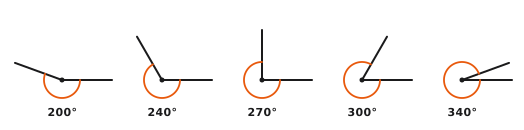
270° is the easiest reflex to picture: three-quarters of a circle, the long-way twin of a right angle. Turning 90° one way or 270° the other lands you facing the same direction. Sharper reflex angles, like 287°, are much harder to read at a glance.
Which angle is the reflex one?
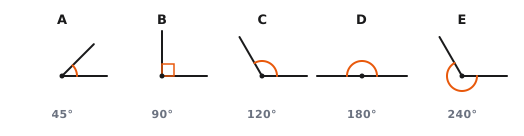
E (240°) is the reflex angle: its arc is drawn the long way round, past the straight line of D (180°). A (45°) and C (120°) are measured on the inside and stay below 180°, and B (90°) is the right angle.
Acute, right, obtuse, straight and reflex angles
| Type of angle | Measures |
|---|---|
| Acute | more than 0°, less than 90° |
| Right | exactly 90° |
| Obtuse | more than 90°, less than 180° |
| Straight | exactly 180° |
| Reflex | more than 180°, less than 360° |
The 360° pairing rule
Every reflex angle has a non-reflex partner sitting at the same vertex. Add the two together and you always land on 360°:
- 200° (reflex) pairs with 160° (obtuse)
- 240° (reflex) pairs with 120° (obtuse)
- 270° (reflex) pairs with 90° (right)
- 300° (reflex) pairs with 60° (acute)
- 340° (reflex) pairs with 20° (acute)
That pairing explains why reflexes get misread. The eye locks onto the small wedge in milliseconds and resists tracing the long arc. Forcing the attention around the back side of the vertex, with a finger if needed, is the practical fix.
Reflex angles in the wild
- Every inward dent on a star or arrow: a reflex angle sits at that vertex.
- A clock face, 12 to 9 going clockwise, measures exactly 270°.
- Pac-Man's mouth is roughly a 90° wedge; the body forms the matching 270° reflex.
- A satellite dish in profile, or any cupped shape seen edge-on.
- The inward-pointing notch of a five-pointed star, around 252°.
Why reflex angles are hard to estimate
Acute versus obtuse is easy: narrower than a corner, wider than a corner, and the brain handles it without effort. Reflex angles behave differently. The eye snaps back to the smaller version of the figure every time. A 240° reflex and a 120° obtuse share the exact same two rays, so a careless read produces the obtuse value by default.
The reliable trick: measure the small angle and subtract from 360°. If the inside looks like 90°, the reflex is 270°. The method is mechanical, but it works. Practice it on Angledle Unlimited, where roughly half the random puzzles fall in reflex range. The daily puzzle yields about one reflex a week, which is not enough volume for the pattern to stick.
Reflex angles inside polygons
A polygon with at least one reflex interior angle is concave (also called "non-convex"). Stars, arrows, and the letter L are all concave. A polygon where every interior angle stays at 180° or below is convex. Pushing one angle past 180° tips the shape into concave territory.
Triangles can't be concave. Their three interior angles add up to exactly 180°, leaving no room for any single angle to exceed that ceiling. Concavity only becomes possible from quadrilaterals upward.
Related reading: acute angles, obtuse angles, and how to estimate angles without a protractor.