Acute Angle: Definition, Degrees and Examples
Acute angles are the ones you meet most: pizza slices, clock hands at one o'clock, roof pitches, the V of geese in flight. Once you can spot one you see them everywhere, and they are the type most people overshoot by a few degrees: a narrow wedge invites a guess that is too high.
What is an acute angle?
In geometry, an acute angle is any angle smaller than a right angle: it measures more than 0° and less than 90°. Picture the tip of a pizza slice or the hands of a clock at one o'clock. The two rays close in on each other rather than opening out, which is what makes the corner look sharp; the word comes from the Latin for sharp.
How many degrees is an acute angle?
Between 0° and 90°, both excluded. That covers 89 whole-number values, from a hairline 1° to an 89° that is almost square, so there is no single measurement to memorise. The acute angles you meet most often are 30°, 45° and 60°; 90° exactly is already a right angle, and anything wider is obtuse.
Five worth knowing by sight
Acute angles span a wide range, from a hairline sliver near 0° up to a near-right angle just shy of 90°. Five values are worth memorizing:
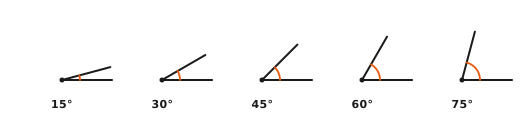
45° is exactly half a right angle. 60° is two-thirds. Anchor those two and most acute angles can be estimated by reading the gap between them.
Real-world examples
- A pizza slice tip, usually 30° to 45°, depending on how generously the shop cuts.
- Clock hands at 1 o'clock land on 30°.
- A pitched roof, typically between 18° and 40° on most houses.
- Geese flying in V-formation.
- The crook of a thumbs-up.
- An open pair of scissors, anywhere from 20° to 60° mid-cut.
Which angle is the acute one?
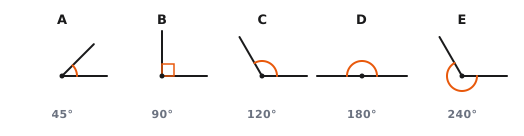
Only A (45°) qualifies: its rays sit closer together than the square corner of B (90°). C (120°) opens past the right angle, so it is obtuse; D (180°) has flattened into a straight line; E (240°) is measured the long way round and is reflex.
Acute, right, obtuse, straight and reflex angles
| Type of angle | Measures |
|---|---|
| Acute | more than 0°, less than 90° |
| Right | exactly 90° |
| Obtuse | more than 90°, less than 180° |
| Straight | exactly 180° |
| Reflex | more than 180°, less than 360° |
Triangles
A triangle's three corners sum to 180°. When all three sit under 90°, the result is an acute triangle. An equilateral, with three 60° corners, is the classic example. A corner of exactly 90° produces a right triangle. A corner above 90° produces an obtuse one.
Because the three angles must sum to 180°, no single corner can exceed 90° in an acute triangle. Infinitely many acute triangle shapes exist, but they all live inside that window.
Complements: acute pairs with acute
Two angles are complementary when they add to 90°. Both halves of a complementary pair are always acute. They have to be: positive numbers adding to 90 leave no room for anything bigger. Common pairs include:
- 30° and 60°
- 45° and 45°
- 20° and 70°
- 10° and 80°
A useful corollary: in any right triangle, the two non-right corners are always complementary. They must sum to 90° so that the three corners hit 180°.
Get better at spotting them
The fastest way to sharpen the eye is to guess first, measure second. The daily Angledle puzzle gives six tries to pin a mystery angle, and roughly a quarter of dailies land somewhere acute. A common error is over-correcting upward: narrow angles look smaller than they are, so the tighter guess is often the right one. For more reps, try Unlimited mode.
More reading: obtuse angles, reflex angles, and eyeballing angles without a protractor.