Obtuse Angle: Definition, Degrees and Examples
Obtuse angles hide in everyday objects — an open laptop, a reclined beach chair, a door swung wide — and are less visually striking than a sharp acute or a sweeping reflex angle, which is exactly why they are easy to misjudge.
What is an obtuse angle?
By definition, an obtuse angle is one that measures more than 90° but less than 180°: wider than the corner of a square, not yet a straight line. A laptop screen tilted back, a reclined seat and a door swung past its frame all show one. The name comes from the Latin for blunt, and blunt is exactly how the corner looks next to a sharp acute angle.
How many degrees is an obtuse angle?
Between 90° and 180°, both excluded, which leaves 89 whole-number values from 91° to 179°. The two boundaries are what trip people up: 90° exactly is a right angle, not obtuse, and 180° exactly is a straight angle. 120° and 135° are the obtuse angles worth knowing by sight, and an obtuse triangle always has exactly one obtuse corner.
Examples across the range
The obtuse range covers 89 integer values, from 91° to 179°. Five useful reference points, drawn at a shared vertex:
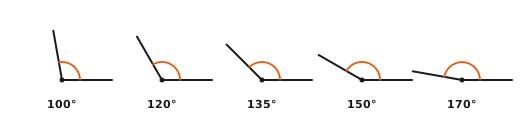
120° is the most useful value to memorize. It is one-third of a full circle, and every interior angle of a regular hexagon: the same angle found in a honeycomb cell. 135° is the other handy landmark: a right angle plus 45°, roughly the angle of a flag at half-mast.
Obtuse angles in everyday life
- A reclined beach chair or sofa back.
- An open book held nearly flat in the lap.
- Every interior corner of a regular hexagon, exactly 120°.
- Clock hands at 4 o'clock land on 120°.
- The bend in a boomerang.
- A door swung past 90° against its frame.
Which angle is the obtuse one?
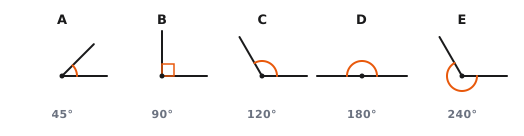
C (120°) is the obtuse one: wider than the square corner of B (90°), narrower than the straight line of D (180°). A (45°) is acute, and E (240°) goes past the straight line, which makes it reflex rather than obtuse.
Acute, right, obtuse, straight and reflex angles
| Type of angle | Measures |
|---|---|
| Acute | more than 0°, less than 90° |
| Right | exactly 90° |
| Obtuse | more than 90°, less than 180° |
| Straight | exactly 180° |
| Reflex | more than 180°, less than 360° |
Obtuse triangles
A triangle with one obtuse interior angle is an obtuse triangle. The arithmetic forces the other two corners to share whatever remains of 180°, which is not much. A 120° angle in one corner leaves only 60° for the other two to split.
A second obtuse angle cannot fit. Two obtuse values alone already exceed 180°. The same reasoning rules out the obtuse-plus-right-angle case. Every triangle gets at most one obtuse corner.
Supplements
Two angles are supplementary when they sum to 180°. An obtuse angle always pairs with an acute one. Common pairs:
- 120° and 60°
- 135° and 45°
- 150° and 30°
- 100° and 80°
Wherever two lines cross, the four resulting angles pair off into two supplementary sets. The same arrangement appears at every corner of a parallelogram.
Practice spotting obtuse angles
Roughly a quarter of daily Angledle puzzles sit in obtuse territory. The hard part is telling 100° from 130° from 160° on sight. A reliable anchor is 135°: a right angle tipped halfway over. Once that value reads cleanly, the others sort themselves out. For more reps, see Unlimited mode.
Related: acute angles, reflex angles, and estimating angles without a protractor.